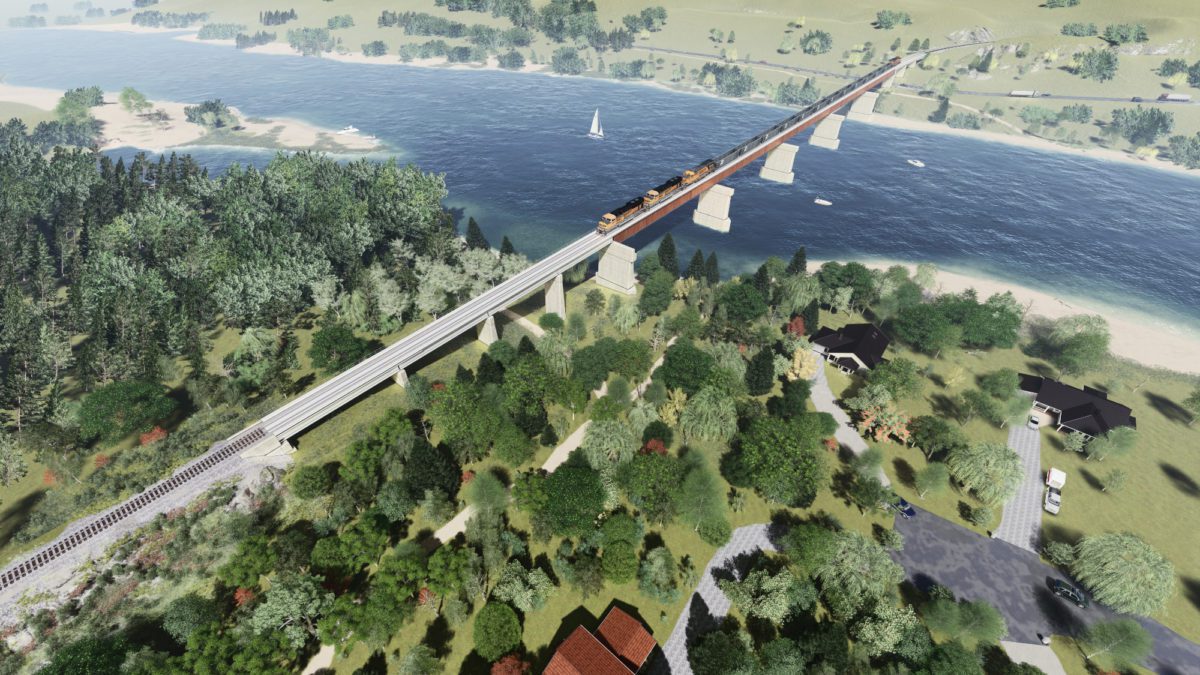
September 2026
Shoring towers are assembled on shore and placed under the center truss of the current bridge to facilitate deconstruction.
Freight rail plays an important role in North Dakota by safely and efficiently connecting families and businesses with the products they use every day.

Since the late 1800s, the existing BNSF railway bridge over the Missouri River that connects Bismarck and Mandan, North Dakota, has helped spur growth and support regional economies. But after 140 years of dutiful service, the bridge is approaching the end of its useful life and needs to be replaced to ensure that freight moves efficiently and safely through the region and that the Bismarck–Mandan area continues to thrive.
Keeping with our commitment to the state and local communities, BNSF Railway is building a new rail bridge adjacent to the existing bridge. The new single-track bridge will support heavier loads, which will better meet our customers’ needs. Keeping the future in mind, the bridge is designed to accommodate potential expansion of a second track to continue supporting efficient freight travel while limiting impact to the Missouri River ecosystem and local communities for generations to come.
Once the new bridge begins servicing trains, the existing structure will be removed.
For nearly a century and a half, BNSF Railway has played an important role in North Dakota’s economy. BNSF’s 32,500-mile network links North Dakota’s agriculture, energy, and other industries to domestic and international markets.
Moving the state’s commodities safely and efficiently requires ongoing investment in BNSF’s privately owned rail infrastructure, which includes its bridge in Bismarck and Mandan. BNSF has invested more than $1.5 billion in its network in North Dakota over the last decade. BNSF has more than 1,100+ employees in North Dakota earning a combined payroll of nearly $100 million a year.